
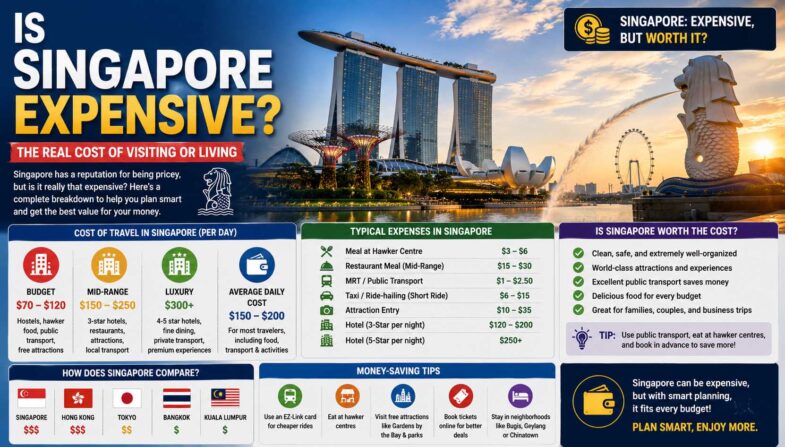
Is Singapore Expensive? A Realistic Travel Cost Guide for 2026
If you are planning a Southeast Asia trip, you may be asking, is Singapore expensive compared with nearby destinations? The short answer is yes, Singapore can feel expensive for accommodation, alcohol, upscale restaurants, and major attractions. However, it does not have to be an expensive trip overall. Public transport is efficient and relatively affordable, hawker centers can keep food costs low, and many of the city’s best neighborhoods, gardens, waterfront areas, and cultural districts can be explored without spending much.
In 2026, hotel prices remain one of the biggest expenses for visitors. Meanwhile, transport remains much easier to manage on a modest budget. Therefore, where you stay and how you choose to eat will usually affect your total trip cost more than getting around the city.
Is Singapore Expensive to Visit in 2026?
Yes, Singapore is expensive to visit if you compare it with destinations such as Malaysia, Indonesia, Thailand, or Vietnam. Still, travelers who compare it only with major cities such as London, Paris, New York, or Zurich may find some expenses surprisingly manageable.
Accommodation is the biggest challenge. Singapore hotel industry data for the first half of 2026 put average room rates at about S$272 per room sold, although economy hotels can be considerably cheaper and luxury properties can cost far more.
Public transportation, on the other hand, remains budget-friendly. Adult card fares for ordinary bus and MRT journeys currently start around S$1.28 and increase with distance, reaching roughly S$2.57 for long journeys over 40.2 km.
As a result, Singapore is unusual: you can spend heavily on your hotel but very little moving around the city.
How Expensive Is Singapore for a Typical Traveler?
Your budget depends heavily on travel style.
A backpacker staying in a hostel, eating mainly at hawker centers, and using the MRT can spend dramatically less than a visitor staying at Marina Bay, dining in restaurants, and visiting several ticketed attractions each day.
Here is a practical daily planning range:
| Travel Style | Approximate Daily Budget per Person* |
|---|---|
| Budget | S$80–S$140 |
| Mid-range | S$180–S$320 |
| Comfortable/upscale | S$400+ |
*These are planning estimates rather than fixed prices. Costs vary by hotel, travel dates, room sharing, attractions, exchange rates, and personal spending.
If two people share a hotel room, the per-person cost can drop significantly. Therefore, couples and families may find Singapore more manageable than solo travelers who need a private room.
Why Is Singapore So Expensive?
Travelers often ask why is Singapore so expensive, especially after comparing accommodation prices with nearby countries.
Several factors contribute. Singapore is a compact, highly developed city-state with limited land, strong demand for centrally located accommodation, high operating costs, and a large international business and tourism market.
Hotel demand is particularly strong. During the first four months of 2026, hotel occupancy remained above 80%, while average room rates were around S$274. Economy properties averaged closer to S$120, while luxury hotels exceeded S$640 per night.
Imported products and alcohol can also feel costly. Likewise, premium shopping, rooftop bars, fine dining, and major branded attractions can push daily expenses up quickly.
However, Singapore’s pricing is not uniformly high. Public transport and local food can still offer strong value.
Accommodation Is Usually the Biggest Expense
For most visitors, accommodation is the part of the trip that makes Singapore feel expensive.
Central neighborhoods such as Marina Bay and Orchard can command high prices, especially at upscale properties.
Meanwhile, areas such as Geylang, Lavender, Little India, Chinatown, and parts of the East may offer more budget-conscious options while still keeping you connected by MRT.
In 2026, Singapore’s average hotel room rate has remained above S$270 in industry data, although actual rates vary widely by hotel category and date.
Therefore, do not judge the destination based on one hotel search.
How to Save on Singapore Hotels
Book early when your dates are fixed, particularly if your trip overlaps with a major event, public holiday, or school vacation period.
Also, compare neighborhoods rather than only hotels around Marina Bay.
Because Singapore’s MRT network makes it easy to move around, staying a few stops away from the most famous attractions can reduce accommodation costs without creating a difficult commute.
Finally, compare the total booking price rather than just the headline room rate. Some travel and hospitality offers may involve taxes or service charges that increase the final bill. Singapore Tourism Board travel-advisor information for 2026 notes that listed participating restaurant and hotel rates may have a 10% service charge and 9% GST added unless otherwise stated.
Food Can Be Surprisingly Affordable
Food is where budget travelers can balance Singapore’s expensive hotels.
Hawker centers, food courts, and casual neighborhood restaurants offer plenty of lower-cost meals. Places such as Maxwell Food Centre, Chinatown Complex, Tekka Centre, and Old Airport Road Food Centre are popular because visitors can try local dishes without committing to restaurant prices.
Depending on what you order and where you eat, a casual hawker meal may cost only a fraction of what you would spend at a sit-down restaurant.
Meanwhile, upscale dining can become expensive quickly, especially once drinks and service charges are involved.
Therefore, a practical strategy is to eat local for breakfast and lunch, then choose one or two restaurant experiences during the trip rather than making every meal a premium one.
Is Singapore Expensive for Transportation?
Compared with accommodation, transportation is one of Singapore’s best-value travel expenses.
The MRT and public bus network covers most areas travelers want to visit, including the city center, airport connections, neighborhoods, and many major attractions.
Singapore uses distance-based fares for buses and trains. As of the current fare schedule, adult card fares begin around S$1.28 for short journeys and rise gradually according to distance.
You can also use eligible contactless payment methods and travel cards through the SimplyGo system.
As a result, you usually do not need taxis for normal sightseeing.
Ride-hailing services can still be useful late at night, when carrying luggage, or when traveling with small children. However, using them for every journey will make the trip noticeably more expensive.
Attractions: Where Your Budget Can Rise Fast
Singapore has many paid attractions, and visiting several in a short trip can add a substantial amount to your budget.
Popular choices include:
- Gardens by the Bay conservatories
- Marina Bay Sands SkyPark
- Singapore Zoo
- Night Safari
- Bird Paradise
- Universal Studios Singapore
- S.E.A. Aquarium
- Singapore Flyer
You do not need to visit all of them.
Instead, choose the two or three attractions that matter most to you and fill the rest of your itinerary with free experiences.
For example, exploring Chinatown, Kampong Glam, Little India, Marina Bay, Jewel Changi Airport’s public areas, and parts of Gardens by the Bay can provide plenty of sightseeing without buying a ticket every few hours.
A Budget Singapore Itinerary Can Still Feel Full
A lower-cost day might begin with breakfast at a local coffee shop or hawker center.
Next, explore Chinatown and walk through nearby cultural streets.
Then, take the MRT to Marina Bay and walk along the waterfront.
Later, visit the outdoor areas of Gardens by the Bay before returning to a hawker center for dinner.
This type of day still includes famous Singapore sights, local food, neighborhoods, and public transportation while avoiding large admission costs.
Therefore, traveling cheaply does not necessarily mean missing the destination’s atmosphere.
When Is the Cheapest Time to Visit Singapore?
Singapore is a year-round destination, so there is no simple off-season that guarantees bargain prices.
Weather stays warm and humid throughout the year, although rainfall patterns vary.
Hotel rates also respond to events, conventions, school holidays, and demand rather than weather alone.
Recent booking data suggests hotel pricing can vary considerably month to month. Therefore, compare several date combinations before buying flights and accommodation rather than assuming one season will always be cheapest.
If your travel dates are flexible, checking flights first can make a big difference. Travelers wondering when is the best time to buy plane tickets should generally compare fares over several weeks and avoid relying on a supposed universal “cheapest booking day.”
Flight prices can change much faster than everyday costs once you arrive.
Singapore vs. Other Asian Destinations
Singapore usually costs more than many popular Southeast Asian destinations.
For example, travelers researching is Bali expensive may find that Bali often offers cheaper accommodation and some lower everyday costs, although luxury resorts and trendy areas there can also become expensive.
Japan presents a different comparison. Accommodation and transport costs vary widely by city and season, so travelers looking for the cheapest time to visit Japan may find opportunities to reduce costs through careful timing.
Singapore, by contrast, has one big budgeting advantage: its compact size.
You do not need domestic flights, long-distance trains, or several hotel changes to see a wide variety of attractions.
Therefore, a four-day Singapore trip can sometimes cost less overall than a longer multi-city itinerary elsewhere, even if the daily price is higher.
Is It Expensive to Live in Singapore?
The question is it expensive to live in Singapore is different from asking about a short visit.
Residents face expenses that tourists usually do not, including long-term housing, utilities, education, transportation choices, insurance, and everyday household spending.
Private housing and car ownership can be particularly costly.
However, tourists should not use Singapore’s reputation as an expensive place to live as proof that every vacation expense will be extreme.
A visitor can rely on public transportation, eat at hawker centers, avoid private housing costs, and stay only a few nights.
Therefore, short-term travel costs and resident living costs should be evaluated separately.
Is Singapore Expensive for Families?
Singapore can work very well for families, although accommodation and attraction tickets may increase the total cost quickly.
The city offers efficient public transport, plenty of food choices, family-oriented attractions, clean public spaces, and relatively easy sightseeing logistics.
For parents comparing the best places to travel with kids, Singapore’s compact layout can be a major advantage because you do not need to spend hours transferring between distant attractions.
Still, families should budget carefully for Universal Studios, wildlife parks, aquariums, and other ticketed activities.
A good approach is to alternate expensive attraction days with free sightseeing days.
For example, one day might include the zoo, while the next could focus on Marina Bay, Chinatown, and Gardens by the Bay’s free outdoor spaces.
Practical Ways to Make Singapore Cheaper
Small choices can make a large difference over several days.
Use the MRT and buses instead of taxis whenever practical.
Eat at hawker centers and food courts rather than restaurants for every meal.
Stay outside the most expensive central hotel zones.
Choose a small number of paid attractions instead of trying to visit everything.
Carry a refillable water bottle where appropriate rather than constantly buying drinks.
Also, avoid impulse spending at premium malls and tourist-heavy entertainment areas if budget matters.
Most of all, set separate budgets for accommodation, meals, attractions, and transportation before the trip. Singapore becomes much easier to manage when you know which category is consuming most of your money.
Common Budget Mistakes to Avoid
The first mistake is assuming everything in Singapore is expensive.
That can lead travelers to skip great experiences unnecessarily.
The second mistake is doing the opposite and ignoring hotel prices until the last minute.
Accommodation can become the dominant trip expense, so book it strategically.
Another common mistake is using taxis for every journey even though the MRT may be just as convenient.
Finally, do not schedule several premium attractions every day without adding up the total cost first. A few individual tickets may look reasonable, yet a family buying four tickets to several attractions can spend a large amount very quickly.
FAQs About Singapore Travel Costs
Is Singapore expensive for tourists?
It can be, especially for hotels, luxury dining, alcohol, and paid attractions. However, public transport and local food make it possible to visit on a moderate budget.
How much money should I budget per day in Singapore?
A budget traveler might aim for roughly S$80–S$140 per person per day, while mid-range travelers may spend around S$180–S$320 or more. Actual spending depends heavily on accommodation and attraction choices.
Is food expensive in Singapore?
It does not have to be. Hawker centers and food courts can offer affordable meals, while restaurants and bars can be considerably more expensive.
Are taxis expensive in Singapore?
They cost more than public transportation. Therefore, most budget travelers can save by using the MRT and buses for everyday sightseeing.
Is Singapore more expensive than Bali?
Generally, Singapore is more expensive for accommodation and several everyday travel costs. However, spending levels in both destinations vary greatly according to travel style.
How many days should I spend in Singapore?
Three to five days works well for many first-time visitors. That gives enough time for Marina Bay, cultural neighborhoods, Gardens by the Bay, local food, and one or two major attractions without rushing.
Plan Around the Expensive Parts, Not the Whole Destination
So, is Singapore expensive? Yes, some parts of a Singapore trip are costly, especially accommodation and premium attractions. Yet the destination is far more budget-friendly than its reputation suggests when you use public transport, eat local food, and balance paid attractions with free sightseeing.
Instead of trying to make every part of the trip cheap, focus on controlling the biggest expenses. Book accommodation carefully, use the MRT, choose hawker centers regularly, and spend money only on attractions you genuinely want to experience.
With that approach, Singapore can work for budget travelers, couples, solo visitors, and families without requiring a luxury-level travel budget.