
Japan Packing List: What to Pack for Every Season and Trip Style
Planning a trip to Japan can feel simple until you start thinking about changing weather, long train journeys, temple visits, city walking, and limited luggage space. A smart japan packing list should help you stay comfortable without turning your suitcase into a burden. The right clothes and essentials also depend heavily on when you travel, where you go, and whether you plan to explore Tokyo, Kyoto, Osaka, Hokkaido, Okinawa, or several regions in one trip.
The good news is that you rarely need to pack everything you own. Japan has excellent convenience stores, pharmacies, supermarkets, and clothing shops, so replacing forgotten basics is usually easy. Instead, focus on versatile clothing, comfortable shoes, weather protection, travel documents, electronics, and a few destination-specific items.
What to Pack for Japan: The Essentials
For most travelers, a packing list for Japan works best when built around layers and versatile pieces. You may encounter cool mornings, warm afternoons, rainy days, heated trains, and air-conditioned hotels during the same trip.
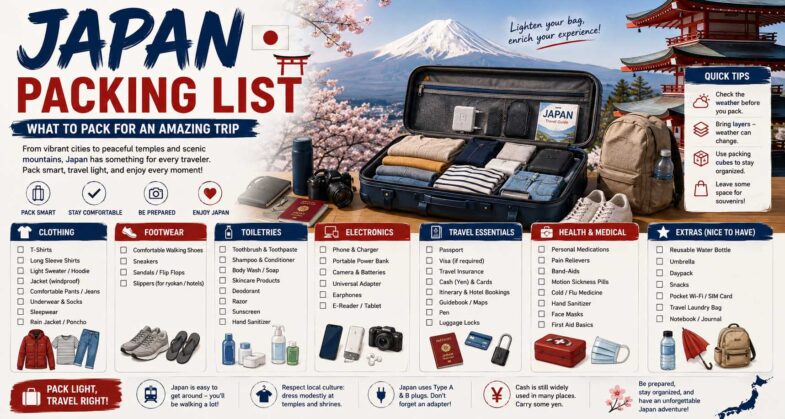
Start with this core japan travel packing list essentials:
- Passport and copies of important travel documents
- Credit or debit cards plus a small amount of Japanese yen
- Comfortable walking shoes
- Lightweight daypack
- Breathable tops
- Versatile trousers or jeans
- Underwear and socks
- Light jacket or sweater
- Compact umbrella or rain jacket
- Phone and charging cable
- Universal travel adapter
- Power bank
- Toiletries and medication
- Reusable water bottle
- Small laundry bag
- Handkerchief or small towel
- Basic first-aid supplies
A small daypack is especially useful because many Japan itineraries involve walking between train stations, neighborhoods, shrines, markets, and restaurants.
Before leaving home, also check your airline’s baggage rules. If you are unsure about cabin luggage limits, reviewing how many ounces can you take on a plane can help when packing liquids and toiletries.
Japan Travel Packing List by Season
Japan experiences four distinct seasons, although conditions vary considerably between northern Hokkaido and subtropical Okinawa. Therefore, the same suitcase will not work equally well for every destination.
| Season | Typical conditions | What to prioritize |
|---|---|---|
| Spring | Mild, changeable, occasional rain | Layers, light jacket, comfortable shoes |
| Summer | Hot, humid, rainy in parts | Breathable clothes, sun protection, rain gear |
| Autumn | Mild to cool, generally comfortable | Layers, light sweater, rain protection |
| Winter | Cold, with snow in northern areas | Warm layers, coat, gloves, suitable footwear |
Spring: March to May
Spring is popular for good reason, but temperatures can vary. March may still feel chilly, while May can be pleasantly warm.
Pack a light or medium jacket, long-sleeved shirts, comfortable trousers, and a compact rain layer. If you plan to visit during cherry blossom season, expect crowds and plenty of walking, so footwear matters more than dressing up.
Late spring can also become warmer and more humid, particularly in major cities.
Summer: June to August
Summer in much of Japan can be hot and humid. June typically brings the rainy season, while July and August can feel particularly warm.
Choose lightweight, breathable clothing. Quick-drying fabrics are useful because you may sweat during long sightseeing days. Sunglasses, sunscreen, a hat, and a small towel are practical additions.
A portable fan can also be useful during hot days, although it is not essential.
Autumn: September to November
Autumn is one of the easiest seasons for a japan travel packing list because temperatures are often comfortable, especially from October into November.
Pack layers that can be added or removed during the day. A lightweight sweater, long-sleeved shirts, trousers, and a light jacket should cover many city itineraries.
Typhoons can affect Japan during parts of the late summer and autumn period, so a rain jacket is worth carrying.
Winter: December to February
Winter packing depends on your route. Tokyo and Osaka can be cold without being extremely snowy, while Hokkaido and mountain areas can be dramatically colder.
For a winter city trip, bring a warm coat, sweaters or fleece layers, thermal base layers, warm socks, and gloves. For skiing or snow-heavy destinations, use proper insulated and waterproof clothing.
If your itinerary includes both Tokyo and Hokkaido, pack for the coldest part of your trip rather than relying on one lightweight wardrobe.
What to Wear in Japan
Japan does not require tourists to follow an elaborate dress code, but respectful clothing is useful when visiting religious and traditional sites.
For temples and shrines, avoid extremely revealing clothing. Comfortable trousers, skirts of reasonable length, and shirts that provide suitable coverage are easy choices.
You may also need to remove your shoes at certain temples, traditional accommodations, and other buildings. Wearing clean socks without holes is a surprisingly useful travel tip.
For everyday sightseeing, prioritize comfort. Japan’s cities are easy to explore by public transportation, but that often means walking farther than expected.
One excellent strategy is to pack a small capsule wardrobe. Choose clothing that works in several combinations rather than bringing separate outfits for every day.
Shoes and Footwear Matter More Than You Think
If there is one part of a packing list for Japan that deserves extra attention, it is footwear.
You may walk several miles a day while exploring neighborhoods and changing trains. Comfortable sneakers or walking shoes should therefore be your primary pair.
Consider bringing:
- One reliable walking shoe
- Comfortable sandals for warm weather, if appropriate
- Lightweight indoor footwear only if your accommodation requires it
Avoid taking several pairs of bulky shoes unless your trip genuinely requires them.
Toiletries, Health Items, and Personal Essentials
Japan has excellent pharmacies and convenience stores, so you do not need to bring huge quantities of toiletries.
Still, bring enough of any personal medication for your entire trip. Keep medicines in their original packaging and check Japanese rules before traveling with prescription or restricted medications.
A compact toiletry kit can include:
- Toothbrush and toothpaste
- Deodorant
- Skincare products
- Sunscreen
- Lip balm
- Prescription medication
- Basic pain relief
- Bandages
- Hand sanitizer
- Travel-size tissues
Japan’s convenience stores are useful for emergency purchases, but familiar products and specific medications may not always be available in the same form you use at home.
Electronics and Travel Gear
Japan uses Type A and Type B electrical outlets, and the standard voltage is 100V. Travelers from countries with different plugs should bring a compatible adapter.
Before packing electronics, check whether your devices support Japan’s voltage range. Most modern phone and laptop chargers do, but older appliances may not.
A practical electronics kit includes:
- Smartphone
- Charging cable
- Wall charger
- Universal adapter
- Power bank
- Earbuds or headphones
- Camera and spare battery, if needed
You do not necessarily need a large camera, tablet, laptop, and multiple accessories. For most leisure trips, a phone can handle navigation, translation, tickets, reservations, and photos.
Luggage Strategy for Japan
Japan is one of those destinations where traveling lighter can make your trip easier.
Large suitcases can become inconvenient on crowded trains, narrow station passages, and busy streets. A medium suitcase or carry-on combined with a small daypack is often more manageable.
If you plan to travel between several cities, consider leaving some room in your luggage. Japan is known for stationery, snacks, clothing, ceramics, souvenirs, and other tempting purchases.
Some hotels and train stations also offer luggage delivery services, which can be helpful when moving between major destinations.
A Simple Seven-Day Packing Checklist
For a typical one-week city trip covering places such as Tokyo, Kyoto, and Osaka, this compact checklist is a useful starting point:
- Passport and travel documents
- 5–7 pairs of underwear
- 4–6 tops
- 2–3 pairs of trousers or equivalent bottoms
- 1 light jacket or sweater
- 1 rain layer or compact umbrella
- Comfortable walking shoes
- Sleepwear
- Toiletries
- Prescription medication
- Phone and charger
- Power bank
- Travel adapter
- Small daypack
- Reusable bottle
- Laundry bag
- Small amount of emergency cash
For longer trips, resist the temptation to multiply every item. Laundry facilities are common, and washing clothes during your trip can dramatically reduce luggage weight.
Packing for a Tokyo, Kyoto, and Osaka Itinerary
A first Japan trip often combines these three cities, and that route does not require radically different clothing.
Tokyo rewards comfortable walking clothes and versatile layers. Kyoto involves extensive walking and visits to temples, so comfortable footwear and respectful clothing are particularly useful. Osaka is similarly casual, with plenty of walking around shopping districts and food neighborhoods.
If you are still deciding how long to spend in Kyoto, researching how many days in Kyoto can help you build a more realistic itinerary before deciding how much luggage to take.
Likewise, if Osaka is a major part of your trip, knowing how many days in Osaka you need can help you avoid packing for a longer trip than you actually have.
What Not to Pack for Japan
Skip oversized toiletries when travel-size versions will work. Avoid bringing too many formal outfits unless your itinerary includes special events. You probably also do not need multiple heavy jackets for a standard city trip.
Do not fill your suitcase completely before departure, either. Leaving some spare space makes souvenirs much easier to handle.
Finally, avoid packing uncomfortable shoes simply because they look good in photos. A beautiful pair that causes blisters can ruin an otherwise enjoyable sightseeing day.
Budget-Friendly Packing Tips
A smart packing list japan strategy can also reduce travel costs.
Bring a reusable bottle instead of buying drinks repeatedly. Pack a few familiar snacks for long journeys, particularly if you have dietary restrictions. Use a refillable toiletry container where practical, and choose clothing that can be washed and reworn.
If you are planning around airfare and accommodation prices, researching the cheapest time to visit Japan can also help you choose a season that fits your overall budget. Your packing needs may change with the weather, but flexible travel dates can sometimes save far more than trying to save luggage weight alone.
Practical Travel Tips Before You Leave
A few final checks can prevent common packing problems.
First, look at the forecast for every destination on your route rather than checking only the weather in Tokyo. Japan stretches across a wide geographic area, so conditions can differ sharply.
Next, download offline maps and keep essential reservation information accessible on your phone. A small printed backup of important information can also help if your phone battery dies.
Finally, leave a little room for unexpected weather. A lightweight rain layer takes up little space but can be extremely useful.
If you are visiting Tokyo for the first time, combining your packing preparation with a seasonal guide to the best time to visit Tokyo can make your clothing choices much more precise.
Japan Packing List FAQs
How many clothes should I pack for Japan?
For a one-week trip, around four to six tops, two or three bottoms, underwear for several days, and one outer layer are usually enough. Plan to do laundry rather than packing a completely new outfit for every day.
Do I need a raincoat for Japan?
A compact rain jacket or umbrella is a good idea year-round. Rainfall varies by season and region, but unexpected showers can happen even when the forecast looks favorable.
Should I bring a suitcase or backpack?
Either can work. However, a medium suitcase with good wheels and a small daypack is often comfortable for a first trip, particularly if you use trains between cities.
What should I pack for Japan in summer?
Choose lightweight, breathable clothing, comfortable walking shoes, sunscreen, sunglasses, and rain protection. Because humidity can be high, quick-drying fabrics are particularly useful.
What should I pack for Japan in winter?
Bring warm layers, a winter coat, gloves, warm socks, and weather-appropriate footwear. If you are heading to Hokkaido or snowy mountain areas, upgrade to proper insulated and waterproof gear.
Is Japan easy to shop for forgotten items?
Yes. Convenience stores, pharmacies, supermarkets, and clothing stores make it relatively easy to replace many everyday essentials. However, specific medications, specialty toiletries, and particular sizes may be harder to find.
Your Final Japan Packing Check
The best japan packing list is not the longest one. It is the list that matches your season, itinerary, comfort level, and destinations.
Before you zip your suitcase, check four things: the weather, how much walking you expect to do, whether your accommodation has laundry facilities, and how many cities you will visit. Then prioritize versatile clothes, reliable shoes, essential documents, electronics, and personal medication.
Japan is a destination where packing less can often mean traveling better. With a practical japan travel packing list built around layers and everyday essentials, you can spend less time managing luggage and more time enjoying the trains, temples, food markets, neighborhoods, and landscapes that make the journey memorable.